Hey you!
Be first one to get the new updates.
Thank you! Your submission has been received!
Oops! Something went wrong while submitting the form.


Be first one to get the new updates.
Understand OpEx vs CapEx in plain English: what they mean, how they affect finance, and how to choose wisely for long-term business strategy.

.jpg)
OpEx vs CapEx are two types of business spending that affect finances differently—OpEx covers everyday running costs, while Capex involves long-term investments like equipment or buildings. Understanding the difference helps businesses make smarter financial decisions about cash flow, taxes, and growth.
Balancing short-term vs long-term needs is the core struggle businesses face when making opex vs capex decisions. In fact, Gartner reports that 69% of IT leaders experienced budget overruns in their organizations’ cloud spending, even though cloud models are meant to boost flexibility and control.
So, how can decision-makers ensure strategic investment today without compromising long-term stability?
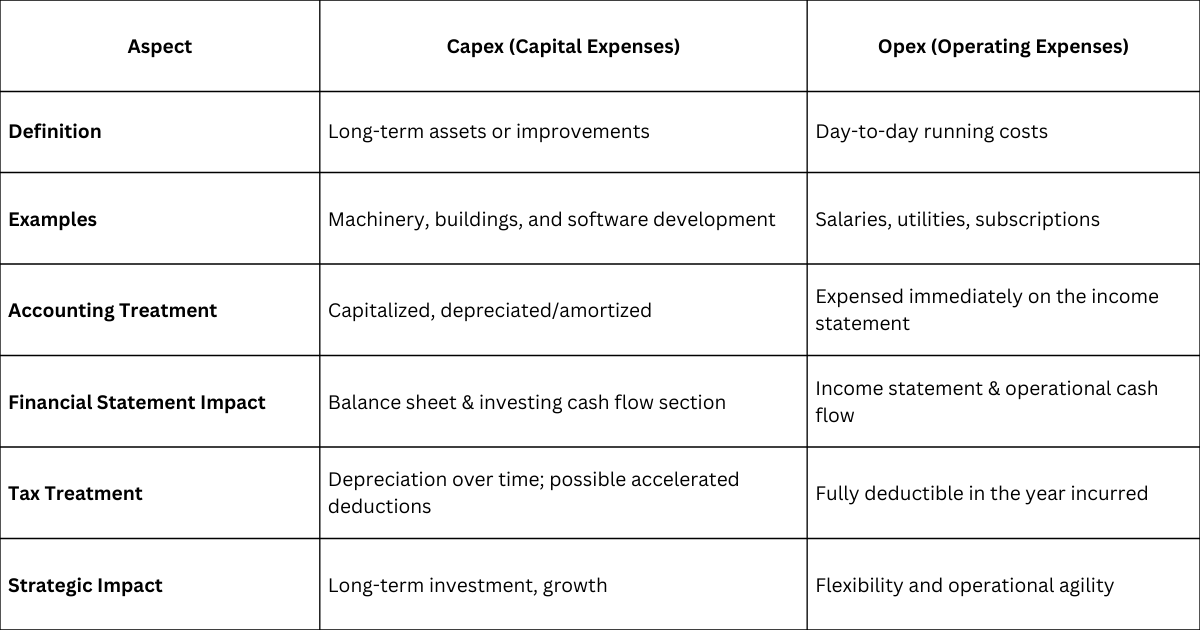
CapEx (Capital Expenditures) refers to spending on long-term assets that provide value beyond the current accounting period. Examples include property, plant, equipment, large software systems, or patents, essentially strategic investments supporting operational capacity or innovation.
Accounting treatment: CapEx is capitalized on the balance sheet and depreciated (or amortized) over the asset’s useful life; it appears in the investing section of the cash flow statement.
OpEx (Operating Expenses) are costs incurred in the everyday operation of a business. These include rent, utilities, salaries, supplies, maintenance, and software subscriptions.
Accounting treatment: OpEx is expensed immediately on the income statement, reducing profit, and is fully deductible in the period incurred.
When thinking about OpEx vs CapEx – strategic business considerations, businesses need to weigh short-term flexibility against long-term investment goals to make smart financial choices.
CapEx supports long-term growth via strategic assets, at the cost of upfront capital. OpEx, conversely, offers flexibility and scalability, often preferred in agile or lean models like SaaS or cloud-based businesses.
CapEx-heavy operations show stronger assets on the balance sheet, which may influence valuation and free cash flow differently from OpEx-driven models. Subscription-based models shifting cost toward OpEx often yield more predictable expense patterns—and may carry higher valuation multiples.
In balancing the two for financial decision-making, companies must find the right mix of CapExand OpEx to manage costs today while investing wisely for future growth.
Effective planning requires a clear CapEx vs OpEx mix. Budgeting for asset investment versus operating cost, alongside scenario planning, ensures sustainable growth.
Decision Criteria and Best Practices
Let’s look at some clear OpEx vs CapEx examples to understand how businesses use them in real life.
Summary Table:
Handling the OpEx vs CapEx balance isn’t just bean-counting, it’s walking a tightrope between today’s quick wins and tomorrow’s solid ground. The difference between capex and opex can make or break your cash flow, taxes, and growth.
Are you pouring money down the drain on short-term fixes, or planting roots for long-term strength? The ball is in your court, every spending choice is a fork in the road. Choose the path that drives lasting success.


